
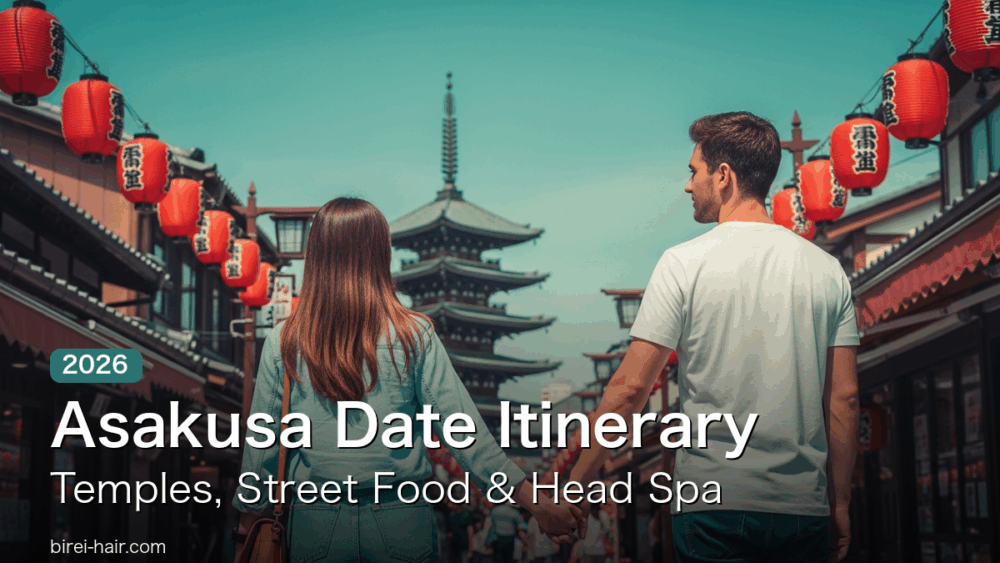
Planning a one-day Asakusa date and wondering how to fit in the temple, the street food, the kimono photos, and still have energy left for dinner? This itinerary walks you and your partner through a full day in Asakusa, hour by hour — from a quiet early morning at Senso-ji to an izakaya alley at night, with one twist most guides skip: a 60-to-90-minute head spa break in the mid-afternoon, exactly when the July heat and 15,000 steps start catching up with you.
We have spent a lot of time in this neighborhood researching salons and walking the same streets you will, and the single biggest upgrade we can suggest for a summer date here is pacing. Asakusa rewards couples who start early, rest in the middle, and come back out for the evening light. Here is how to do exactly that.
Your One-Day Asakusa Date at a Glance
| Time | What You Are Doing | Why This Timing Works |
|---|---|---|
| 7:30 – 9:00 | Senso-ji Temple and Kaminarimon, almost to yourselves | Tour groups arrive from about 10 AM; mornings are cooler and photo-friendly |
| 9:30 – 10:30 | Nakamise-dori street food as the shutters open | Fresh batches, no lines yet |
| 10:30 – 13:00 | Kimono rental stroll, or a rickshaw ride, then lunch | Photos before the harshest midday sun |
| 14:00 – 15:30 | Head spa break for two (60-90 min) | The hottest, most crowded hours — spend them lying down in air conditioning |
| 16:00 – 18:30 | Kuramae coffee stroll, Sumida River terrace, Skytree views | Softer light, cooler air, golden-hour photos |
| 19:00 – | Izakaya dinner on Hoppy Street | The lantern-lit alleys are at their best after dark |
* Written for summer 2026. In July and August, Tokyo afternoons regularly reach 34-35°C with high humidity — the midday rest block is not optional comfort, it is what keeps the evening half of the date alive.
7:30 AMSenso-ji Before the Crowds
Start at Kaminarimon, the giant red lantern gate that fronts every Asakusa postcard. At 7:30 in the morning you can stand directly under the lantern for a photo without a single stranger in the frame — try that same shot at 11 AM and you will be sharing it with two hundred people. The temple grounds themselves never close, and the main hall opens at 6 AM in summer, so early risers are genuinely rewarded here.
Walk the length of Nakamise-dori while the roughly ninety shops are still shuttered. This is not wasted time: the closed shutters are painted with murals of Asakusa’s festivals and seasons, a detail most visitors never see because the shutters are up by the time they arrive. Pass through Hozomon gate, look up at the giant straw sandal hanging on its wall, and take your time at the main hall and the five-story pagoda while the incense smoke is still thin.
Before you leave, draw an omikuji fortune slip together (100 yen each). Asakusa’s omikuji are famous for dealing out bad luck slips more generously than most temples — if one of you draws a bad one, tie it to the rack, laugh it off, and consider it a story for later. There are English explanations on the back.
Crowd-dodging tip: If you cannot do 7:30, aim for before 9 AM at the latest. By 10 AM the tour buses have unloaded and Nakamise becomes a slow-moving river of people. And in July, those early hours are also 5-6 degrees cooler — your kimono photos later will thank you.
9:30 AMStreet Food on Nakamise and the Side Streets
Loop back down Nakamise as the shops open around 9:30-10:00 and eat your way through it. The classics are classics for a reason: a fresh-baked jumbo melonpan (crisp outside, cloud inside), ningyo-yaki sponge cakes molded into pagodas and lanterns and filled with red bean paste, age-manju deep-fried buns, and kibi-dango millet dumplings dusted in soybean flour, sold with a cup of chilled amazake in summer.
Two pieces of etiquette that will make you look like you have done this before. First, eating while walking is frowned upon here — buy your snack, then step to the side of the stall and eat it standing there. Most shops have a small standing space and a trash box for their own packaging. Second, carry cash; many of the older stalls still do not take cards.
If the main street is already thick with people, slip one block over to Denboin-dori or the covered Shin-Nakamise arcade. Same festive atmosphere, a fraction of the foot traffic, and a few of the best snack stands are there anyway.
10:30 AMKimono Stroll or Rickshaw Ride, Then Lunch
Asakusa is Tokyo’s kimono-rental capital, and doing it as a couple is genuinely fun rather than gimmicky — plenty of shops offer couple plans where you both get dressed, and staff will point you to the most photogenic corners. Expect around 3,000-6,000 yen per person depending on the plan, plus a little extra for hair styling. Book online a day or two ahead in summer; the popular shops fill up. You will typically need to return the kimono by 4:30-5:30 PM, which is exactly why this itinerary schedules the stroll before lunch and the head spa after.
Not a kimono couple? Take a rickshaw instead. The runners who pull them double as bilingual local guides and photographers, and a 30-minute route for two (roughly 9,000-11,000 yen per couple) covers back streets you would not find on your own. It feels touristy because it is — and it is still one of the most fun 30 minutes in Asakusa.
For lunch, keep it local: a tendon (tempura rice bowl) at one of the old-school specialists west of the temple, unagi if you are celebrating, or cold soba if the heat has already gotten to you. Aim to sit down by 12:30, before the office crowd, and return the kimono after lunch if you rented one — you want your own clothes for what comes next.
2:00 PMThe Head Spa Break: The Best Date Idea Nobody Tells You About
Here is the honest truth about a full day in Asakusa in July: by 2 PM you have walked well over 10,000 steps, much of it on sun-baked pavement, and the temperature is peaking. This is the stretch where most couples either wilt in a cafe for two hours or push through and arrive at dinner exhausted and slightly cranky. There is a better option.
A head spa is a Japanese scalp-and-pressure-point treatment — 60 to 90 minutes in a dim, silent, air-conditioned room while a therapist works on your scalp, temples, neck, and shoulders. It is one of Japan’s favorite wellness rituals, and Asakusa happens to have several salons where couples can receive treatments at the same time.
Why does a head spa slot into a date so well, specifically here and specifically in summer?
Most first-timers fall asleep within twenty minutes, wake up wondering where the hour went, and describe the after-feeling as a lighter head and wider-open eyes. If that sounds like a strange thing to do on a date, we would gently point out that it beats standing in one more line.
Where to Book: Three Salons That Fit This Itinerary
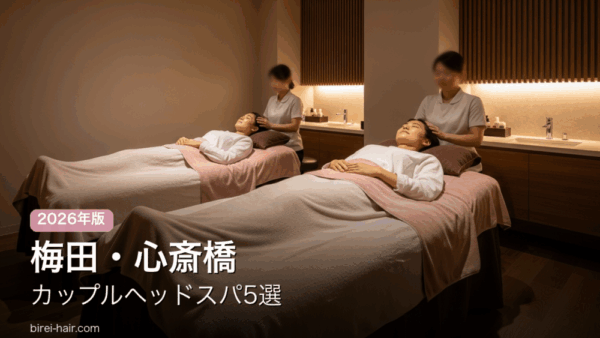
These three are all within the Asakusa area covered by this route. We compare them (and two more in nearby Ueno) in detail in our guide to the best head spas for couples in Asakusa and Ueno — but for a date-day booking, here is the short version.
Meinou — Zen Dry Head Spa, 2 Minutes from TX Asakusa Station
Our top pick for this itinerary. Meinou is a dry head spa specialist in Nishi-Asakusa with a Japanese-modern interior and a deliberately tiny capacity — three reservations a day, which means the room is always calm. Because no water is involved, whatever hair styling survived the morning survives the treatment too.
Couples are not a standard menu item, but the salon can often arrange side-by-side times if you contact them a few days ahead via LINE or WhatsApp — and they are one of the few salons in the area reachable on WhatsApp at all, which makes them unusually easy for overseas visitors to coordinate with.
- Price
- 50 min: 6,900 yen / 70 min: 8,900 yen per person
- Pair Booking
- Contact via LINE or WhatsApp in advance
- Hours
- 9:00 AM – 10:30 PM (reservation only)
- Access
- Tsukuba Express Asakusa Station, 2-minute walk
MIROKU Asakusa — Pair Plans on a Budget, Right by the River
The most budget-friendly way to do this together, and the easiest to book: MIROKU has actual couple plans on Hot Pepper Beauty — 60 minutes for two at 10,000 yen total, or 90 minutes combining head spa, foot reflexology, and body massage at 15,000 yen for two. After a morning of walking, the foot reflexology option is not a small selling point.
Location-wise it sits just across the Sumida River near Azumabashi bridge, which happens to be exactly where this itinerary sends you afterward for Skytree views. It is open late too, so it also works as a post-dinner option if you would rather keep the afternoon for sightseeing.
- Price
- Pair 60 min: 10,000 yen (2 people) / Pair 90 min: 15,000 yen (2 people)
- Pair Booking
- Couple plans bookable directly on HPB
- Hours
- Weekdays 11 AM – 11 PM / Weekends 10 AM – 11 PM
- Access
- Honjo-Azumabashi Station (Asakusa Line), A3 exit, 10 seconds
nico Kuramae — Herbal Head Spa for Couples Who Do Not Mind Taking Turns
One stop south in Kuramae — the coffee-and-craft neighborhood this itinerary strolls through anyway — nico takes a traditional-medicine-inspired approach: a consultation first, then herbal oils chosen for whatever is bothering you, whether that is eye strain, poor sleep, or a stiff neck from a long-haul flight.
The honest caveat: it is a single-therapist salon, so you cannot be treated at the same time. The workaround is pleasant, though. Book back-to-back 70-minute sessions; one of you gets treated while the other explores Kuramae’s cafes and leather-goods studios, then you swap. Note that payment is cashless only.
- Price
- 70 min: 8,300 – 8,800 yen per person
- Pair Booking
- Back-to-back solo sessions
- Hours
- 9:00 AM – 8:30 PM (open year-round)
- Access
- Kuramae Station (Oedo Line A5 exit), 1-minute walk
Never done a head spa before? Our first-timer’s guide to Japanese head spas covers what happens during a session, what to wear, tipping (there is none), and the small etiquette points — worth a five-minute read before you book.
4:00 PMKuramae Coffee, the Sumida River, and Skytree at Golden Hour
You will come out of the salon around 3:30-4:00 feeling suspiciously awake. Use it. If you booked nico, you are already in Kuramae — one of Tokyo’s most quietly stylish neighborhoods, full of single-origin coffee roasters, chocolate makers, and studios selling hand-bound notebooks and leather goods. Pick up an iced coffee and wander back north along the river.
The stretch of the Sumida River terrace between Kuramae and Azumabashi bridge is the payoff walk of this whole itinerary. By 5 PM the light has gone soft, the worst heat has broken, and Tokyo Skytree stands directly across the water. The classic couple photo is from Azumabashi bridge itself, with the Skytree and the golden Asahi building in one frame. If you have energy for a detour, Sumida Park lines both banks — and if you would rather sit than walk, the water bus (Tokyo Cruise) departs from the pier right at Azumabashi for a river ride toward Hamarikyu Gardens or Odaiba.
Summer evening bonus: In late July, this riverbank hosts the Sumida River Fireworks Festival, one of Tokyo’s biggest. If your dates line up, plan around it — and book absolutely everything in advance, because the whole city shows up.
7:00 PMIzakaya Night on Hoppy Street
End where Asakusa is most itself: Hoppy Street, a lantern-lit strip of open-front izakaya west of the temple, named after the retro beer-like drink that locals mix with shochu. Order hoppy because you should, then eat the street’s specialty — slow-stewed beef tendon (gyusuji nikomi) — alongside grilled skewers and whatever the hand-written specials board suggests via your translation app.
Seats are elbow-to-elbow plastic stools, the atmosphere does most of the talking, and many places are cash-only, so hit an ATM first (the convenience stores around the station all have them). Go around 7 PM to get a table without a wait. And if you skipped the afternoon head spa in favor of more sightseeing, remember MIROKU across the river takes bookings until late — a 60-minute pair session at 9 PM is a very good way to land a long day.
Frequently Asked Questions
For the highlights, yes — comfortably, if you start early. This route covers the temple, the food streets, a kimono or rickshaw experience, a head spa, and the river without ever feeling rushed, precisely because it does not try to cram the midday hours. If you have a second day, pair Asakusa with Ueno’s museums and park, fifteen minutes away — our Asakusa and Ueno head spa guide covers that side of the river too.
Two to three days ahead is usually enough on weekdays; for a weekend date, book as soon as your plans are firm. Pair arrangements need the most lead time — MIROKU’s couple plans can be booked directly on Hot Pepper Beauty, while Meinou’s side-by-side sessions are arranged by messaging them on LINE or WhatsApp a few days out. Hot Pepper Beauty is in Japanese, but Chrome’s auto-translate handles the booking flow fine, and your overseas phone number works in the form.
Roughly 30,000-40,000 yen for two, all in: street food snacks (about 2,000 yen), kimono rental (8,000-12,000 yen for two with hair styling), lunch (3,000-5,000 yen), the head spa (10,000-15,000 yen for two depending on the salon and course), and an izakaya dinner with drinks (6,000-8,000 yen). A rickshaw ride adds about 10,000 yen. Skip the kimono and it becomes a very reasonable 20,000-25,000 yen day.
This is why the order of this itinerary matters. Return the kimono (and let them take down the formal updo) before your treatment, then choose a dry head spa — no water, no shampoo, no oil in the basic courses — and your everyday hairstyle and makeup come through intact. If you want to keep an elaborate hair set for evening photos, do the head spa another day or pick a treatment focused on neck and shoulders instead.
Final Thoughts
The couples who enjoy Asakusa most are not the ones who see the most things — they are the ones who match the neighborhood’s rhythm. Senso-ji belongs to the early morning, the food streets to mid-morning, and the riverbank to golden hour. The midday gap in between is not a flaw in the plan; it is where the plan breathes. Whether you fill it with a side-by-side session at Meinou, a bargain pair course at MIROKU, or back-to-back herbal treatments in Kuramae, that ninety minutes of quiet is what turns a long hot sightseeing day into a date you both actually remember fondly.
If you are still deciding which salon fits you best, our full comparison of couple-friendly head spas in Asakusa and Ueno breaks down all five options by price, pair availability, and atmosphere. Book a couple of days ahead, start your morning at the lantern gate, and let the day unfold from there.

コメント