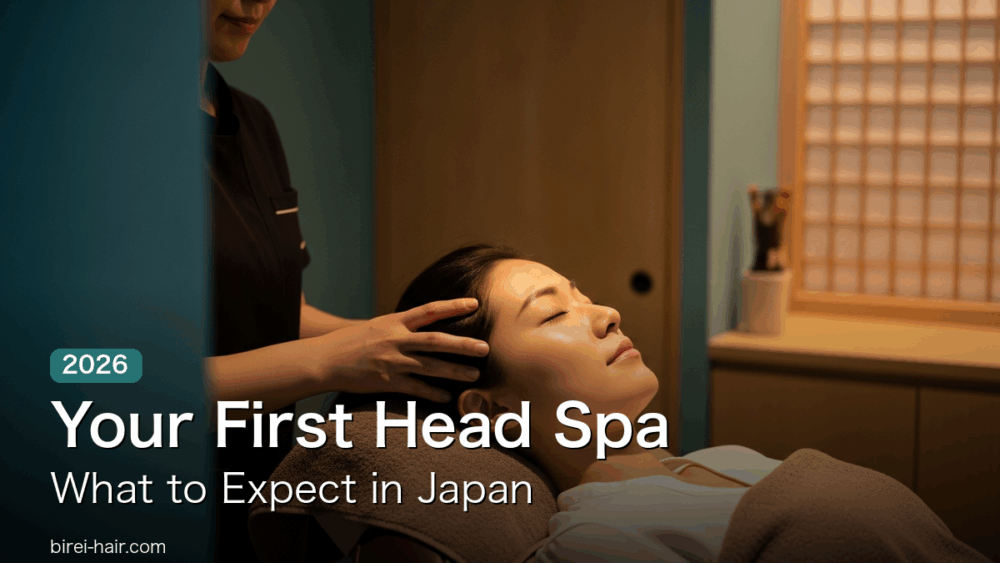
You keep seeing head spa videos from Japan on your feed — someone reclining in a dim room while a therapist works slow circles across their scalp — and now it is on your Tokyo itinerary. But the practical questions pile up fast. What actually happens in there? Do you need to speak Japanese? Should you tip? Will your hair be a mess afterward?
We have sat in those chairs more times than we can count, and we still remember how confusing the first booking felt. The good news: a Japanese head spa is one of the easiest wellness experiences a visitor can try. There is no undressing, no small talk expected, and no tipping to calculate.
Below we answer every question we hear from first-timers — what to expect step by step, how to book, the etiquette that matters, and which Tokyo salons are the most comfortable if you only speak English.
What Actually Happens During a Japanese Head Spa?
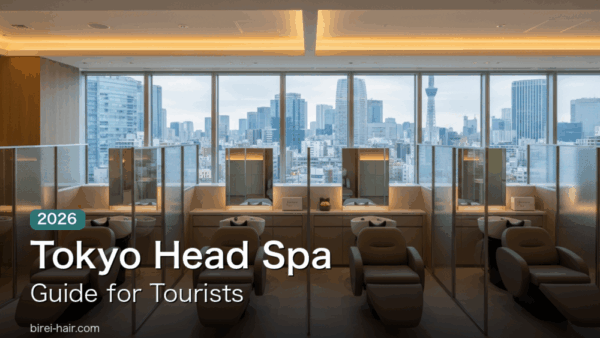
Short answer: You recline in a chair or on a bed in a quiet, dimly lit room while a therapist massages pressure points on your scalp, temples, neck, and shoulders for 30 to 90 minutes. Most sessions are fully clothed, no water involved, and many guests fall asleep.
A typical first visit follows the same rhythm almost everywhere. Here is the sequence, so nothing takes you by surprise:
- Check-in and consultationYou give your name, then fill out a short consultation card — where you feel tension (head, eyes, neck, shoulders), sleep quality, and any conditions the therapist should know about. If the card is in Japanese, pointing at your problem areas works perfectly well.
- Settling inYou are guided to a reclining chair or a flat treatment bed. Shoes off, belongings in a basket or locker, blanket over your legs. The lights go down and quiet ambient music comes on.
- The treatmentThe therapist works through your scalp zone by zone — hairline, temples, crown, the base of the skull — then usually the neck and shoulders. Pressure is firm but slow. If it ever feels too strong, a simple “soft, please” is understood at most salons.
- The wake-upSessions end gently: lighter strokes, a warm towel on the neck or eyes, and the chair slowly raised. Do not be embarrassed if you were asleep. Falling asleep is considered a sign the treatment worked.
- Aftercare chat and paymentThe therapist may briefly explain what they noticed (a stiff right shoulder, tension above the ears) and suggest how often to come. You pay at the desk — card is fine at most places — and that is it. No tip.
One thing worth knowing before you book: “head spa” covers a few different styles. A dry head spa uses no water or oil, so you leave with your hairstyle intact — ideal if you have dinner plans afterward. A wet head spa adds shampoo and scalp cleansing at a wash basin, which feels amazing but means restyled hair. If you are not sure which suits you, our guide to what a dry head spa is and how it works breaks down the differences.
How Do I Book a Head Spa in Japan?
Short answer: Most salons take reservations through Hot Pepper Beauty (beauty.hotpepper.jp), a Japanese booking site that works fine with your browser’s translation feature. Book 2 to 3 days ahead, and use your overseas phone number — it is accepted.
Walk-ins are rare in this industry. Japanese head spa salons are usually small — two to five chairs, sometimes a single therapist — so nearly everything runs on advance reservations. The standard route:
- Open the salon’s Hot Pepper Beauty pageTurn on Chrome or Safari translation. The layout is the same for every salon: photos on top, coupon menu below.
- Pick a couponFirst-visit coupons (“新規” means new customer) are usually the cheapest way in. Check the duration — 60 minutes is the sweet spot for a first session.
- Choose a date and timeGreen circles mean available. Weekday afternoons have the most open slots.
- Fill in the formName (Roman letters are fine), phone number (your home country number works), and email. You will get a confirmation email in Japanese — screenshot it to show at check-in.
Some salons also take bookings through Instagram DM, LINE, or WhatsApp, which can be easier if you want to ask questions in English first. We list a WhatsApp-friendly salon in the recommendations below.
Do I Need to Tip at a Japanese Head Spa?
Short answer: No. Tipping is not practiced anywhere in Japan’s salon industry, and offering one can create genuine awkwardness. The listed price is the full price.
This is the question we get most often from North American readers, so let us be direct: do not tip. There is no tip line on the receipt, no tip jar, and no expectation. If a therapist gave you the best hour of your trip, the appreciated gestures are saying “kimochi yokatta desu” (that felt great), leaving a review on the salon’s booking page, or simply booking again. Those mean far more here than cash ever would.
What Should I Wear to a Head Spa?
Short answer: Whatever you are already wearing. For a dry head spa you stay fully clothed. For wet or oil treatments, the salon provides a gown or towels. Just avoid stiff collars and complicated earrings.
There is no dress code, and you will never be asked to undress for a standard head spa. A few practical notes from experience: skip high, stiff collars (the therapist works on your neck), take out earrings and remove glasses before the session starts, and if you booked a treatment involving oil, do not wear your most delicate silk shirt. Makeup is fine for dry head spas — it stays untouched. For wet courses, assume your hair will need restyling and plan the rest of your day accordingly.
Head Spa Etiquette: What Are the Unwritten Rules?
Short answer: Arrive five minutes early, keep your voice low, silence your phone, and do not cancel last-minute. Everything else, the staff will guide you through.
Japanese salons run on quiet precision, and a little awareness goes a long way. These are the points that actually matter:
Will the Staff Speak English?
Short answer: Usually only a little — but it rarely matters. The experience is almost entirely non-verbal, and a translation app covers the consultation card. A few Tokyo salons do have English-capable staff.
Head spa is one of the most language-proof experiences in Japan. After the consultation card, you may not exchange another word until checkout. That said, having a few phrases ready makes the visit smoother and tends to delight the staff:
| When | Say | Meaning |
|---|---|---|
| At check-in | Yoyaku shimashita | I have a reservation |
| During consultation | Koko ga tsurai desu (pointing) | This area is bothering me |
| If pressure is too strong | Mou sukoshi yowaku | A little softer, please |
| If it feels great | Kimochi ii desu | That feels good |
| At checkout | Kimochi yokatta desu | That felt great, thank you |
Google Translate’s camera mode handles the consultation card and any signage. If you would rather not deal with any language gap at all, pick one of the salons below — we chose them specifically because they are easy for English speakers.
Which Tokyo Salons Are Easiest for English Speakers?
We have visited dozens of head spa salons across Tokyo, and for a first visit as a foreign traveler, these three are the ones we keep recommending. One has English-capable staff, one takes WhatsApp messages, and one is simply so well-run that language never becomes an issue.
| # | Salon | Area | Price (per person) | English Support | Type |
|---|---|---|---|---|---|
| 1 | YumeSpa Ginza | Ginza | From 13,800 yen | English-capable staff | Wet / fascia therapy |
| 2 | Meinou | Asakusa | From 6,900 yen | WhatsApp, some English | Dry head spa |
| 3 | Vanish | Ebisu | From 5,800 yen | Translation app friendly | Dry head spa |
* Prices shown are the lowest available first-visit rates as of July 2026. Tax included. Actual prices vary by menu and date.
1YumeSpa Ginza — English-Capable Staff in Central Tokyo
If the language barrier is your main worry, start here. YumeSpa is one of the few head spa salons in Tokyo with staff who can genuinely communicate in English — not just gestures and goodwill, but actual explanations of what they are doing to your scalp and why. For a first-timer who wants to understand the experience, that changes everything.
Their signature treatment is scalp fascia therapy: slow, deep work that releases the connective tissue across the skull, paired with an Indonesian-style cream bath option that deep-cleanses the scalp. It is a wet treatment, so plan for restyled hair — but the post-session lightness around your temples is something you will be describing to people back home.
Ginza’s location makes it easy to fold into a shopping or dinner itinerary, and the salon’s polish matches the neighborhood. Of the three picks here it is the most expensive, and in our view the most worth it for a milestone treat.
- Price
- 70 min cream bath: 13,800 yen / 90 min fascia therapy: 15,800 yen
- Hours
- Mon-Fri 10:00 AM – 8:00 PM / Weekends & holidays 10:00 AM – 10:00 PM
- Access
- Ginza Station, 4-minute walk / Higashi-Ginza Station, 3-minute walk
- Treatment Type
- Wet head spa, cream bath, scalp fascia therapy
- Language
- English-capable staff — rare in this industry
2Meinou — WhatsApp Booking Near Senso-ji
Meinou solves the booking anxiety a different way: you can message them on WhatsApp (+818041686393) before you ever arrive. Ask about times, mention it is your first head spa, tell them your neck has been wrecked by airplane seats — some English communication is possible, and being able to sort details in advance takes the stress out of the visit.
The salon itself is a quiet, Japanese-modern space in the backstreets of Nishi-Asakusa, and they accept only three guests per day. That limit means your session never feels rushed and you never wait in a lobby. It is a dry head spa, so you walk out with your hairstyle and makeup exactly as they were — just with your shoulders noticeably lower than when you walked in.
If your itinerary includes Senso-ji (it almost certainly does), this is the natural pick: a morning at the temple, lunch on Hoppy Street, then an hour of silence two minutes from Tsukuba Express Asakusa Station.
- Price
- 50 min: 6,900 yen / 70 min: 8,900 yen / 100 min: 11,800 yen
- Hours
- 9:00 AM – 10:30 PM (reservation only)
- Access
- TX Asakusa Station, 2-minute walk. Nishi-Asakusa 3-5-11, 2F
- Treatment Type
- Dry head spa (no water, hairstyle stays intact)
- Language
- WhatsApp available (+818041686393), some English communication possible
3Vanish — Tokyo’s Highest-Rated Head Spa, First-Timer Priced
Vanish in Ebisu is where we send people who ask “just tell me the best one.” It holds one of the highest ratings of any head spa specialist on Hot Pepper Beauty, and the 50-minute first-visit course at 5,800 yen is the best value-for-skill ratio on this list. No English-speaking staff, but the operation is so smooth — clear gestures, dialed-in pressure, impeccable timing — that our sessions there have involved fewer words than a hotel elevator ride.
The technique leans therapeutic rather than purely relaxing: they find the exact spots behind your ears and along your skull base that a week of travel walking and hotel pillows have locked up. If you are the type who wants results you can feel the next morning, this is your salon.
Ebisu itself is a bonus — one of Tokyo’s best eating neighborhoods, one stop from Shibuya. Book an evening slot, then reward your newly weightless head with dinner nearby.
- Price
- 50 min: 5,800 yen / 75 min: 9,500 yen / 90 min: 13,800 yen
- Hours
- Weekdays 11:00 AM – 10:00 PM / Weekends 10:00 AM – 10:00 PM, open year-round
- Access
- JR Ebisu Station East Exit, 7-minute walk. Ebisu 4-23-14, AS Bldg 5F
- Treatment Type
- Dry head spa (therapeutic style)
- Language
- Japanese primarily; Google Translate is plenty
Frequently Asked Questions
Expect 5,000 to 10,000 yen for a standard 50-70 minute session, using a first-visit coupon. Premium salons in Ginza or hotel spas run 13,000-16,000 yen. Short 30-minute intro courses can be found for 3,000-5,000 yen. Compared to what a comparable scalp treatment costs in New York or London, most visitors find Tokyo prices pleasantly reasonable.
Courses run 30, 50, 60, 90, or occasionally 100+ minutes. For a first visit, 50-60 minutes is the sweet spot: long enough to reach the deeply relaxed state the treatment is famous for, short enough to fit between sightseeing stops. Nearly everyone who books 30 minutes tells us afterward they wished they had gone longer.
Not if you choose a dry head spa — no water, no oil, no product. Your hairstyle survives intact, which is why dry courses are popular before dinner reservations. Wet courses and oil treatments do leave hair needing a restyle; most salons offer a blow-dry finish, but bring a hair tie just in case.
The opposite — therapists take it as a compliment. Japanese head spa technique is specifically designed to switch your nervous system into rest mode, and drifting off within the first 15 minutes is completely normal. Snoring happens. Nobody minds. Consider it proof you got your money’s worth.
Sometimes, but do not count on it. Small salons fill their day quickly, and single-therapist shops may have zero same-day availability. Booking 2-3 days ahead is the safe play, and weekday afternoons are your best odds for short-notice slots. If you must try same-day, check Hot Pepper Beauty around 10-11 AM when cancellations appear.
Yes — tell the salon (in the booking notes or via translation app) if you are pregnant, have neck or spine injuries, recent surgeries, high blood pressure, or scalp conditions. Many salons treat pregnant guests with adjusted positioning, but policies differ, so ask when booking rather than at the door. When in doubt, a quick message ahead of time saves everyone an awkward moment.
Final Thoughts
Of all the experiences we recommend to visitors, a head spa is the one with the smallest gap between “sounds intimidating” and “is actually effortless.” You book online with a translated page, show up five minutes early, point at where your neck hurts, and then do absolutely nothing for an hour while someone highly trained fixes the damage your flight did. No tipping math, no dress code, no conversation required.
If you want the softest possible landing, book YumeSpa in Ginza and let the English-speaking staff walk you through everything. If your trip revolves around Asakusa, message Meinou on WhatsApp and sort it all out before you arrive. And if you simply want the best hands in Tokyo at the friendliest price, Vanish in Ebisu is the booking to make. Whichever you choose, book the longer course — your future self, half-asleep in a dim room somewhere in Tokyo, will be grateful you did.

コメント