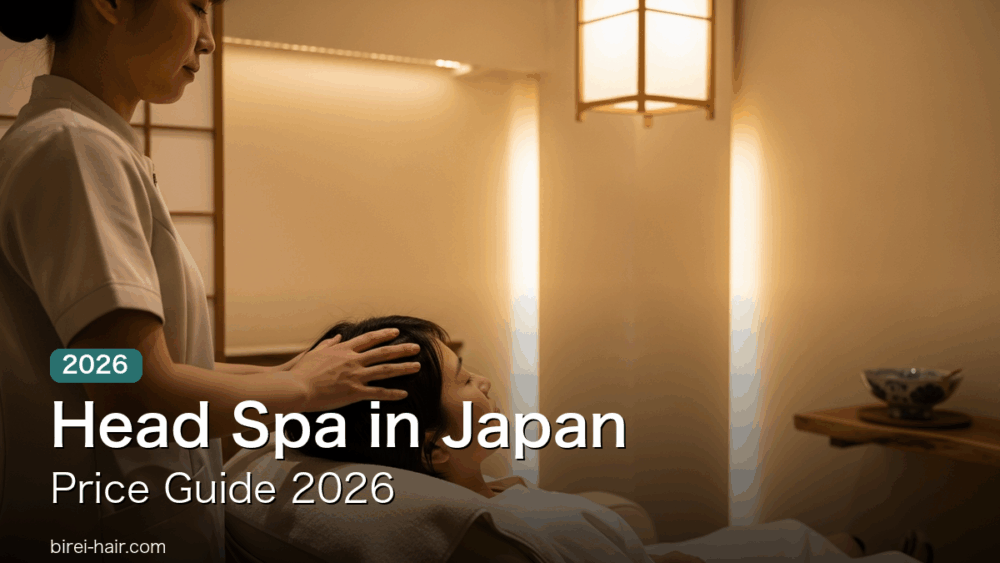
You have decided a Japanese head spa belongs on your itinerary. Then you start looking at prices and the numbers make no sense: one blog says “as cheap as $20,” a hotel spa quotes $180, and the booking sites show everything in yen with no context for what is normal and what is a tourist markup.
We run a head spa review site in Japan and have paid our own way into more than 50 salons across Tokyo, Osaka, and beyond — so we know exactly what these treatments cost locals, where the good value hides, and which “cheap” listings come with a catch. All figures below are typical ranges as of July 2026, in yen with rough US dollar equivalents.
Short version up front: a proper 60-minute session at a specialist salon usually lands between 5,000 and 8,000 yen (about $33-53), and with Japan’s first-visit coupon culture you can often pay less than that for your first time. Here is the full picture.
How Much Does a Head Spa Cost in Japan?
Short answer: A standard 60-minute head spa at a specialist salon typically costs 5,000-8,000 yen (roughly $33-53 USD). Budget options start around 3,000 yen ($20), luxury salons run 13,000-25,000 yen ($87-167), and first-visit coupons commonly cut 20-50% off. Tax is included and there is no tipping.
The single most useful number to carry in your head is “about 1,000 yen per 10 minutes” for a dry head spa at a specialist salon. A 60-minute session around 6,000 yen is right in the middle of the market. Industry surveys of salons listed on Hot Pepper Beauty, Japan’s dominant booking platform, put the most common menu price near 5,000 yen, with specialist 60-minute courses averaging around 7,000 yen.
Anything dramatically cheaper usually has an explanation — a shorter session than the label suggests, a first-visit-only rate, or a quick add-on at a hair salon rather than a full treatment. Anything dramatically more expensive is either a luxury salon with scalp diagnostics and private rooms, or a hotel spa pricing for convenience. Neither is a scam; they are just different products, which is exactly what the next section unpacks.
* All prices in this guide are typical ranges as of July 2026, based on Hot Pepper Beauty listings and industry surveys. Individual salons vary. USD figures assume roughly 150 yen to the dollar — treat them as ballpark estimates.
What Does Each Type of Head Spa Cost?
Short answer: Dry head spas (no water) run 4,000-8,000 yen per hour. Wet or oil head spas run 7,000-12,000 yen. A quick add-on at a hair salon costs 2,000-5,000 yen, and luxury scalp clinics charge 13,000-25,000 yen. The Japanese-trend “head water bath” (toshinyoku) is usually a wet-course add-on around 1,000-3,000 yen.
“Head spa” is an umbrella term in Japan, and the price differences between styles are big enough that comparing a dry salon to a cream-bath salon is like comparing a coffee stand to a cocktail bar. Here is how the market breaks down:
| Type | Session Length | Typical Price (JPY) | Approx. USD | What You Get |
|---|---|---|---|---|
| Hair salon add-on | 10-30 min | 2,000-5,000 yen | $13-33 | Quick scalp massage with a haircut or color |
| Dry head spa | 40-60 min | 4,000-8,000 yen | $27-53 | No water or oil; pressure-point work, hairstyle intact |
| Wet / oil head spa | 60-90 min | 7,000-12,000 yen | $47-80 | Shampoo-basin scalp cleansing, carbonated water or aroma oil |
| Head water bath (toshinyoku) | 10-20 min add-on | +1,000-3,000 yen | +$7-20 | Warm water cascading over the scalp; usually added to a wet course |
| Luxury scalp salon | 60-120 min | 13,000-25,000 yen | $87-167 | Microscope scalp diagnosis, private room, premium products |
Dry head spa — the traveler’s default
If you are picturing the viral videos — someone fully clothed in a dim room, slowly losing consciousness while fingers work their scalp — that is a dry head spa, and it is the best-value category in the country. No water, no oil, no changing rooms, and your hairstyle survives, so you can walk straight from the session to dinner. Competition among dry specialist chains has been fierce for the last few years, which keeps 60-minute prices in the 4,000-8,000 yen range and often lower with coupons. If you are unsure what the treatment actually involves, our plain-English explainer on what a dry head spa is and how it works covers it step by step.
Wet and oil head spas — pay more, get the deep clean
Wet courses move you to a shampoo basin for actual scalp cleansing — carbonated water rinses, aroma or herbal oils, clay masks, sometimes a blow-dry finish. The higher price partly reflects the products used, and partly the longer sessions. The post-treatment feeling is genuinely different from a dry course: your scalp feels scrubbed, not just released. The trade-off is practical — your hair gets wet, so budget restyling time into your day.
Head water bath — the trend you have seen on your feed
The toshinyoku (“head water bath”), where warm water streams continuously over your scalp while you lie back, exploded on Japanese social media and is now spreading through salons nationwide. It is rarely sold alone: most salons offer it as a 10-20 minute add-on to a wet course for an extra 1,000-3,000 yen, though a few specialists build full courses around it. Worth trying once for the sensation alone — it is as close as you will get to being a river stone.
Luxury salons — a different product entirely
At the top end, salons in Ginza or Omotesando offer microscope scalp diagnostics, certified hair-care specialists, fully private rooms, and 90-120 minute treatments that can pass 20,000 yen. Locals treat these as a once-or-twice-a-year reward rather than a routine. If this trip is a special occasion, the experience gap between a 6,000 yen session and a 16,000 yen one is real — but nobody needs the luxury tier to understand why Japan is obsessed with head spas.
Are Head Spas Cheaper Outside Tokyo?
Short answer: Yes. Central Tokyo is the most expensive market — roughly 5,500-9,800 yen for a dry 60 minutes. Osaka and Nagoya run 1,000-2,000 yen cheaper for comparable quality, Fukuoka cheaper still, and regional cities like Sapporo can be 2,000-3,000 yen below Tokyo.
If your route covers more than one city, it can genuinely pay to schedule your head spa outside Tokyo. Typical 60-minute ranges by area:
| Area | Dry 60 min | Wet 60 min | Approx. USD (dry) | Notes for travelers |
|---|---|---|---|---|
| Central Tokyo | 5,500-9,800 yen | 8,000-13,000 yen | $37-65 | Priciest, but the widest choice and most English support |
| Osaka | 4,500-7,500 yen | 6,500-11,000 yen | $30-50 | Best value-for-skill in Japan; Shinsaibashi is packed with salons |
| Kyoto | 4,500-8,000 yen | 7,000-12,000 yen | $30-53 | Tourist-area salons price higher; cheaper near Karasuma |
| Nagoya | 4,000-7,000 yen | 6,000-10,000 yen | $27-47 | Birthplace of the big dry head spa chains, very competitive |
| Fukuoka | 3,500-6,500 yen | 5,500-9,000 yen | $23-43 | New-salon boom means aggressive pricing |
| Regional cities (Sapporo, Sendai) | 3,000-6,000 yen | 5,000-8,000 yen | $20-40 | Cheapest, fewer salons, less English |
Two caveats from experience. First, the spread inside Tokyo is bigger than the spread between cities: a salon in Ginza and a salon in Ikebukuro can differ by 3,000 yen for a comparable hour, because rent, not technique, drives much of the price. Second, cheaper regions come with less English support and fewer salons used to foreign guests — fine if you have done a head spa before, worth weighing if it is your first. Osaka hits the sweet spot on both counts, and our Osaka head spa guide for tourists lists the salons we would actually send you to.
Why Is My First Visit So Much Cheaper?
Short answer: Japan’s salon industry runs on first-visit coupons — discounts of 20-50% for new customers, listed on the booking page. They are a normal, expected way to book, not a gimmick. As a tourist you qualify at every salon, every time.
This is the part of Japanese salon culture that surprises visitors most. Open any salon’s page on Hot Pepper Beauty and the menu is dominated by coupons marked 新規 (shinki — “new customer”): a 6,900 yen course offered at 4,900 for first-timers, a 90-minute premium course with 3,000 yen knocked off. Salons use these to compete for first visits and win repeat customers, and everyone books this way. You are not gaming the system by using them; you are using the system.
For travelers this is close to a cheat code. You are, by definition, a new customer everywhere you go. A realistic first-visit budget for a very good 60-minute dry head spa is 4,000-5,500 yen (about $27-37) in Tokyo, and less in Osaka or Fukuoka.
One honest note: the flip side of coupon culture is that the second visit costs the regular price, which is how those “60 minutes for 3,980 yen” listings stay in business. Locals have to care about that. On a two-week trip, you mostly do not — although if you fall in love with a salon and want to return before you fly home, check the regular price before assuming the number you paid last time.
How Do I Actually Book the Cheap Prices?
Short answer: Book through Hot Pepper Beauty (beauty.hotpepper.jp) with your browser set to translate. Pick a coupon marked for new customers, choose a weekday daytime slot if you can, and book 2-3 days ahead. Your overseas phone number works.
The prices in this article are Hot Pepper Beauty prices — the platform where nearly every specialist salon lists its menus and where the first-visit coupons live. Booking takes about five minutes:
- Open the salon’s Hot Pepper Beauty page with translation onChrome or Safari auto-translate handles the whole flow. Every salon page uses the same layout: photos on top, coupon menu below.
- Choose a coupon, not the regular menuCoupons marked 新規 (new customer) are the cheap way in. Check the minutes — 60 is the sweet spot for a first session — and check whether the price is labeled tax-included, which it almost always is.
- Pick a weekday daytime slot for the best availability and pricesSome salons run additional weekday 11 AM-3 PM discounts, and short-notice availability is far better on a Tuesday afternoon than a Saturday.
- Fill in the form with your detailsName in Roman letters, your home-country phone number, and email all work fine. Screenshot the confirmation email to show at check-in.
If the booking flow itself is the part that intimidates you, our first-visit guide to Japanese head spas walks through the whole experience — booking, etiquette, what happens in the room — question by question.
Do I Tip? Are There Hidden Costs?
Short answer: No tipping — ever. The listed price is the full price, tax included. The only extras are optional and clearly flagged: therapist nomination fees (500-1,000 yen), mid-session extensions (about 1,000-1,500 yen per 10 minutes), and product add-ons you approve first.
Coming from North America, the pricing here is refreshingly literal. There is no tip line, no tip jar, and offering cash will cause polite confusion rather than gratitude. If the session was wonderful, say “kimochi yokatta desu” (that felt great), leave a review on the booking page, or book again — those are the gestures that register.
The few legitimate extras worth knowing about:
What Do Real Salon Prices Look Like?
Ranges are useful, but nothing beats concrete examples. These are three Tokyo salons we have visited and recommend to English-speaking readers — deliberately chosen as one budget, one mid-range, and one premium, so you can see what each price tier actually buys.
| # | Salon | Area | Price Tier | From (per person) | Type |
|---|---|---|---|---|---|
| 1 | Vanish | Ebisu | Budget | 5,800 yen (~$39) | Dry head spa |
| 2 | Meinou | Asakusa | Mid-range | 6,900 yen (~$46) | Dry head spa |
| 3 | YumeSpa Ginza | Ginza | Premium | 13,800 yen (~$92) | Wet / fascia therapy |
* Lowest listed first-visit rates as of July 2026, tax included. Actual prices vary by menu and date.
1Vanish — What 5,800 Yen Buys at a Top-Rated Salon
Vanish is our standing answer to “where is the best value in Tokyo?” The 50-minute first-visit course at 5,800 yen sits at the bottom of the central-Tokyo price range, yet the salon holds one of the highest ratings of any head spa specialist on Hot Pepper Beauty. That combination — floor-level price, ceiling-level reviews — is exactly what the “evaluate by rating times review count” rule looks like in practice.
The style is therapeutic rather than purely soothing: they hunt down the knots behind your ears and along the skull base that a long-haul flight and hotel pillows install, and you feel the difference the next morning. No English-speaking staff, but the operation is so smooth that language never becomes a problem.
- Price
- 50 min: 5,800 yen / 75 min: 9,500 yen / 90 min: 13,800 yen
- Hours
- Weekdays 11:00 AM – 10:00 PM / Weekends 10:00 AM – 10:00 PM, open year-round
- Access
- JR Ebisu Station East Exit, 7-minute walk. Ebisu 4-23-14, AS Bldg 5F
- Treatment Type
- Dry head spa (therapeutic style)
- Language
- Japanese primarily; Google Translate is plenty
2Meinou — Mid-Range Pricing, Three Guests a Day
Meinou shows what the middle of the market buys you: 6,900 yen for 50 minutes in a quiet Japanese-modern room in the Asakusa backstreets, at a salon that accepts only three guests per day. That guest limit is the value here — no lobby wait, no rushed transitions, a session that feels private without private-room prices.
It is also the easiest booking on this list for nervous first-timers: you can message them on WhatsApp (+818041686393) before you arrive, and some English communication is possible. A natural fit if your itinerary already includes Senso-ji — temple in the morning, an hour of silence two minutes from Tsukuba Express Asakusa Station in the afternoon.
- Price
- 50 min: 6,900 yen / 70 min: 8,900 yen / 100 min: 11,800 yen
- Hours
- 9:00 AM – 10:30 PM (reservation only)
- Access
- TX Asakusa Station, 2-minute walk. Nishi-Asakusa 3-5-11, 2F
- Treatment Type
- Dry head spa (no water, hairstyle stays intact)
- Language
- WhatsApp available (+818041686393), some English communication possible
3YumeSpa Ginza — Where the Premium Tier Starts Making Sense
At 13,800 yen for a 70-minute cream bath, YumeSpa costs more than double the budget tier — and it is the clearest demonstration of what that extra money buys. The signature scalp fascia therapy works the connective tissue across the skull with slow, deep pressure, paired with an Indonesian-style cream bath that deep-cleanses the scalp. It is a wet treatment, so plan for restyled hair.
The other thing you are paying for is rare in this industry: staff who can genuinely explain in English what they are doing to your scalp and why. For a milestone treat — end of a long trip, a birthday, an anniversary — this is the premium-tier booking we suggest first.
- Price
- 70 min cream bath: 13,800 yen / 90 min fascia therapy: 15,800 yen
- Hours
- Mon-Fri 10:00 AM – 8:00 PM / Weekends & holidays 10:00 AM – 10:00 PM
- Access
- Ginza Station, 4-minute walk / Higashi-Ginza Station, 3-minute walk
- Treatment Type
- Wet head spa, cream bath, scalp fascia therapy
- Language
- English-capable staff — rare in this industry
Frequently Asked Questions About Head Spa Prices
Usually, yes — and often by a lot. Comparable scalp treatments at spas in New York or London commonly start around $80-150 before tip, while a top-rated Tokyo specialist charges $35-55 all-in with no tipping. Factor in the current exchange rate and the skill level of therapists who do nothing but scalps all day, and head spas are one of the best wellness values in Japan.
Around 5,000-6,000 yen ($33-40) covers a very good 60-minute first-visit session at a dry specialist in Tokyo, and 4,000-5,000 yen does the same in Osaka or Fukuoka. If you want the premium wet-course experience, budget 12,000-16,000 yen. Bring 10,000 yen in cash if you have not confirmed the salon takes cards.
Convenience-wise, maybe; value-wise, rarely. Hotel spas in Tokyo commonly charge 15,000-30,000 yen for scalp treatments that a specialist salon delivers for a third of the price — you are paying for the robe, the elevator ride, and the ability to book in English through the concierge. If English booking is the concern, a specialist salon with English-capable staff solves it for far less.
Listed prices usually stay the same, but the cheapest coupons often carry weekday-only or daytime-only conditions, so the price you can actually book is frequently higher on a Saturday. Availability is the bigger issue — weekend slots at popular salons disappear days in advance. If your schedule allows, a weekday afternoon is cheaper and calmer.
At most specialist salons in Tokyo and Osaka, yes — Visa and Mastercard are widely accepted, and many salons also take tap payments. Small single-therapist studios are the exception and may be cash-only. Note that you pay at the salon, not when booking: Hot Pepper Beauty reservations require no deposit or card in most cases.
Pay for 60. The 3,000-4,000 yen 30-minute courses are fine as a sampler, but the deeply relaxed, half-asleep state the treatment is famous for typically arrives 20-30 minutes in — exactly when a short course ends. Nearly everyone we know who booked 30 minutes came out saying they wished they had gone longer. The extra 2,000 yen is the best-spent money of the whole experience.
Final Thoughts
Here is the whole article in one paragraph: budget about 6,000 yen ($40) for a great 60-minute head spa in Tokyo, less elsewhere, use the first-visit coupon on Hot Pepper Beauty, and do not tip anyone. The listed price is the real price, tax included, and the “cheap” end of the Japanese market delivers a level of skill that would cost triple back home.
If you are deciding where to spend that budget: first-timers who want maximum value should book Vanish in Ebisu, anyone staying near Asakusa can sort everything over WhatsApp with Meinou, and if this trip calls for one proper splurge, YumeSpa in Ginza is where the premium tier earns its price. Whichever tier you pick, book the 60-minute course over the 30 — the last half of a head spa is the part you flew here for.


コメント